
Signs of Mold Behind Drywall and When to Open the Wall
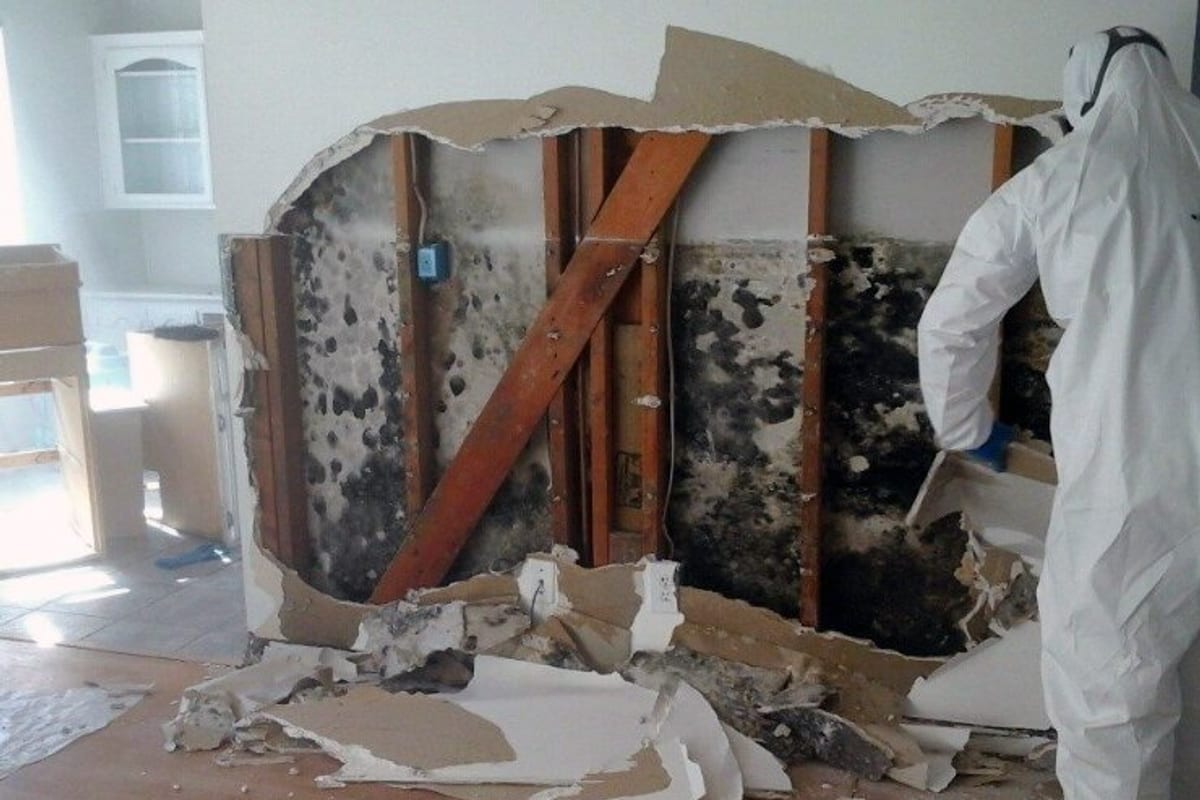
Mold behind drywall usually shows up as a combination of clues, such as a musty smell, staining or bubbling paint low on the wall, swollen baseboards, and moisture meter readings that stay high, rather than as visible growth on the painted side. One sign alone is a reason to look closer. Two or three together, plus wet readings, is usually a reason to open the wall.
This guide covers the outside signs that point to hidden growth, how to use a moisture meter on drywall without fooling yourself, the less destructive ways to look inside, and how to decide when and where a wall should be cut.
Why Mold Grows on the Back of Drywall
Drywall is a gypsum core wrapped in paper. The paper is what mold eats. On the room side, the paper is covered with primer and paint, which slows things down a little. On the cavity side, the paper is bare, dark, and still. If water gets into the wall cavity from a plumbing leak, a window or siding leak, or condensation on a cold exterior wall, the back face of the drywall can stay wet much longer than the front.
The EPA says wet building materials should be dried within 24 to 48 hours to prevent mold growth. Inside a closed wall, with insulation holding water against the paper, that window is easy to miss. That is how a wall can look normal from the room and be heavily grown on the back.
Outside Signs That Point to Hidden Mold
None of these proves there is mold. Each one tells you water has been in or near the wall.
Changes to the wall surface
- Staining that is yellow, brown, or gray, often with a darker outline where water stopped spreading.
- Bubbling, blistering, or peeling paint, especially low on the wall or below a window.
- Soft or crumbly drywall that gives when you press with a thumb.
- Small dark speckles coming through the paint. By the time growth shows through, the back side is usually worse.
Changes at the base of the wall
- Swollen or separated baseboard, particularly MDF baseboard, which puffs up when wet.
- Staining or rot on the tack strip under carpet along the wall.
- Cupped hardwood or lifting vinyl next to the wall.
Other clues
- A musty smell strongest near one wall or coming from an outlet box. See our guide on tracking a musty smell with no visible mold.
- A known leak in the past that was fixed but never opened up and dried.
- What is on the other side. A shower, washing machine, water heater, outside hose bib, or a window directly above is a likely source.
How to Use a Moisture Meter on Drywall
A moisture meter is the most useful tool a homeowner can buy for this question, as long as you use it to compare, not to read absolute numbers.
There are two kinds:
- Pinless meters have a flat pad that reads moisture about 3/4 inch (19 mm) into a material without making holes. They are good for scanning a whole wall quickly.
- Pin meters push two small pins into the material and measure electrical resistance between them. They give a reading at one spot and work well on wood framing and trim.
Most inexpensive meters show a wood-scale number, or a 0-100 relative scale. Gypsum does not read the same as wood, so a number on drywall is not a true moisture content.
The comparison method
- Take readings on an interior wall you know is dry, in the same room if possible. That is your baseline.
- Scan the suspect wall in a grid, about every 12 inches (30 cm), from the floor up to about 4 feet (1.2 m) and around any window or fixture.
- Mark any spot that reads clearly higher than the baseline with painter’s tape.
- Re-check those spots a few days later, and again after a rain or after the nearby fixture has been used.
A spot that stays high over several days, or gets higher after rain or use, is wet inside. A spot that was high once and is now normal may have been a surface reading from a recent spill or condensation.
What can throw off readings
| False reading | Why it happens |
|---|---|
| Metal corner bead, nails, screws | Metal reads as wet on most meters |
| Foil-faced insulation or foil backing | Same as metal |
| Plumbing or wiring right behind the drywall | Pinless meters can pick it up |
| Fresh paint or joint compound | Can still hold moisture for days |
| Plaster over lath in older homes | Reads differently from drywall; compare plaster to plaster |
If you have an older home with plaster walls rather than drywall, our guide to mold on plaster walls in old homes covers how those walls behave differently.
Wood framing readings
Where you can reach framing with a pin meter, such as from a basement below the wall or through a small hole, wood readings are more meaningful. Dry interior framing in a conditioned house usually reads in the single digits to low teens on the wood scale. Wood that sits around 19% to 20% or higher for an extended period is wet enough to grow mold and, over time, to rot.
Less Destructive Ways to Look Inside
Before cutting a large opening, there are a few ways to confirm what is there.
- Remove an outlet or switch cover (power off at the breaker first) and look into the gap with a flashlight. You will see the edge of the drywall and sometimes the insulation and framing.
- Pull the baseboard. Pry it off carefully with a flat bar and a wood block. The bottom inch or two of drywall behind it is often where growth starts, and the baseboard covers any small inspection holes you make.
- Borescope camera. An inexpensive inspection camera fed through a 1/2 inch (13 mm) hole shows the inside of the cavity: the back of the drywall, insulation, and studs.
- Wall cavity air sample. An inspector draws air through a small hole into a spore trap and sends it to a lab. This can confirm hidden growth when there is a smell but nothing visible. Our guide to mold inspection vs. mold testing explains when sampling is worth the cost.
- Thermal camera. It shows cool spots that are often wet, which tells you where to take meter readings. It does not see mold or see through walls.
When to Open the Wall
Open the wall when moisture readings stay high after the source has been stopped, when there was a leak that soaked the wall for more than 24 to 48 hours, or when a small inspection hole shows growth. Leaving wet drywall and insulation closed up keeps mold growing and can lead to damaged framing.
Use this as a rough decision guide:
| Situation | Usual next step |
|---|---|
| One high reading, no smell, no history | Re-check in a few days; watch the spot |
| High readings that persist, no smell | Find and fix the source, then dry; open if it does not dry |
| Known leak, wall wet more than 48 hours | Open the lower section to dry and inspect |
| Musty smell plus high readings | Small inspection opening or borescope |
| Visible growth through paint | Plan for removal of that section and beyond |
| Wall soaked by flood or sewage | Remove the affected drywall and insulation |
Fixing the source comes first. Opening a wall and cleaning it while a pipe still drips just resets the clock.
Where to cut
- Cut low. Water runs down, so the bottom of the wall is usually the worst. A common first cut is a strip from the floor to about 2 feet (60 cm) up, which can be extended.
- Cut between studs with a shallow cut so you do not hit wiring or pipes. Locate studs first and check for outlets and plumbing on both sides.
- Look at the back of the piece you remove. If it is clean and dry, you may be done. If it is stained or grown, keep going until you reach clean, dry material, plus some margin.
How to open it safely
Disturbing moldy drywall releases spores and dust into the room. The EPA’s guide to mold, moisture and your home recommends gloves, goggles, and at least an N95 respirator for small cleanups. It says a homeowner can usually handle an area smaller than about 10 sq ft (0.9 m²). Inside a wall, you often do not know the size until it is open.
For a small inspection opening:
- Close the room and turn off the HVAC so the system does not carry dust through the house.
- Lay plastic on the floor under the work area.
- Mist the surface lightly to keep dust down. Do not soak it.
- Cut with a utility knife or oscillating tool rather than a saw that throws dust.
- Bag the removed drywall in heavy plastic and seal it before carrying it through the house.
- HEPA vacuum the area and wipe surfaces with a damp cloth.
If what you find is larger than a small patch, stop, cover the opening with plastic and tape, and get an assessment. Our guide on whether DIY mold removal is safe goes into where a homeowner should draw the line.
What Happens After the Wall Is Open
Once the cavity is exposed, a proper repair follows a predictable order, consistent with the IICRC S520 standard for professional mold remediation:
- Stop the water and confirm with meter readings that it has stopped.
- Contain the area with plastic sheeting and, for larger jobs, negative air pressure through HEPA filtration so spores do not move to clean rooms.
- Remove affected porous materials, which means moldy drywall and wet insulation. Drywall with growth on it is not cleaned and reused.
- Clean the framing with HEPA vacuuming and wiping. Sanding or wire brushing may be needed where growth has stained the wood surface.
- Dry the cavity until framing reads back to normal levels.
- Verify, with a visual check, moisture readings, and sometimes air sampling, before the wall is closed.
- Rebuild with new insulation and drywall.
Frequently Asked Questions
Can mold behind drywall make you sick if you cannot see it?
It can affect indoor air, because spores and fragments pass through outlet boxes, gaps, and cracks. Sensitive people may notice allergy-type symptoms, coughing, or worse asthma. The CDC’s mold pages describe the common reactions. Whether a particular wall affects a particular person is a question for a doctor, but the right step for the house is the same either way: find the source and remove the growth.
Can I just cut out the moldy part and patch it?
For a small area with a fixed moisture source, often yes. Cut back to clean, dry material with some margin, check the framing and insulation, dry everything, and then patch. If the growth runs past what you expected, or framing is involved, it is no longer a patch job.
How long does drywall have to be wet before mold grows?
The EPA’s guidance is to dry wet materials within 24 to 48 hours to prevent mold. Inside a wall with wet insulation against it, drywall can stay wet much longer than that even after a leak is fixed, which is why opening the bottom of the wall is often part of drying it.
Does homeowners insurance pay to open a wall and look?
It depends on the policy and the cause. Sudden, accidental water damage is treated differently from long-term leaks or humidity. This is general information, not legal or insurance advice; read your policy and talk with your agent. Water damage exclusions and mold limits are common, so check the wording.
If a wall reads wet, smells musty, or has been through a leak that was never opened up, our mold inspection and testing service can map the moisture and tell you whether and where it needs to be opened before you cut anything. Contact us to set up a visit.